AIIMS Delhi holds the #1 spot in NIRF 2025 dental rankings with a score of 89.12. Saveetha Institute of Medical and Technical Sciences, Chennai, is the top private dental college at #2. Admission to all BDS programs happens only through NEET UG. Government college fees start around Rs. 10,000 per year. Private college fees can go up to Rs. 25 lakhs per year.
When I help students map out their medical careers, the question I hear most often is simple: which are the best dental colleges in India, and do I have a real shot at getting in?
It is a fair question, and an important one. Choosing the wrong college can cost you years and lakhs of rupees. Choosing the right one can shape your entire career.
Every year, thousands of NEET UG aspirants chase a BDS seat without knowing the full picture. They do not know the real fee structures. They do not know the actual cutoffs. They do not know which colleges are ranked, verified, and worth the investment.
This guide gives you all of that. No fluff. Only facts
Why Study Dentistry in India Today?
India has fewer than 2 dentists per 10,000 people. That gap means massive career opportunities for new dental graduates entering the field right now.
The infrastructure has also improved significantly. Top dental colleges today offer advanced simulation labs, digital radiology, and research centers that match global standards.
Here is why dentistry makes strong career sense in 2025:
- Job demand is rising. Government health schemes like Ayushman Bharat are expanding oral healthcare access across rural and urban India.
- Private practice potential is high. A well-established dental clinic in a Tier 1 or Tier 2 city can generate Rs. 5 to 15 lakhs per month.
- Specialization adds more value. After BDS, an MDS degree in orthodontics or oral surgery significantly multiplies your earning potential.
- Global recognition is growing. Indian dental degrees from top NIRF-ranked colleges are increasingly accepted for licensing exams abroad.
The ROI on a BDS degree from a reputed college is real, provided you choose wisely from the start.
Convert CGPA to Percentage
Instantly convert your CGPA into percentage using the correct formula for your needs.
Convert NowThe Ultimate List of 15 Top Dental Colleges in India (NIRF 2025)
The list below is based on the official NIRF 2025 Dental Rankings released on 4th September 2025. These are the only verified rankings you should trust when making your college decision.
- AIIMS Delhi, New Delhi (Government)
- Saveetha Institute of Medical and Technical Sciences, Chennai (Private)
- Maulana Azad Institute of Dental Sciences (MAIDS), New Delhi (Government)
- Dr. D. Y. Patil Vidyapeeth, Pune (Private)
- Manipal College of Dental Sciences (MCODS), Manipal (Private)
- A.B. Shetty Memorial Institute of Dental Sciences, Mangalore (Private)
- King George’s Medical University (KGMU), Lucknow (Government)
- SRM Dental College, Chennai (Private)
- Siksha ‘O’ Anusandhan University, Bhubaneswar (Private)
- JSS Dental College and Hospital, Mysuru (Private)
- Post Graduate Institute of Dental Sciences (PGIDS), Rohtak (Government)
- Sri Ramachandra Institute of Higher Education and Research, Chennai (Private)
- Amrita Vishwa Vidyapeetham, Coimbatore (Private)
- Banaras Hindu University (BHU), Varanasi (Government)
- Nair Hospital Dental College, Mumbai (Government)
A few quick observations from this list worth noting:
- Government colleges dominate the top spots where pure academic output and research are measured.
- Private deemed universities like Saveetha and Manipal punch well above their weight in research and infrastructure.
- South India has a noticeably strong presence, with multiple private colleges from Tamil Nadu and Karnataka making the top 15.
- Delhi alone has three strong government dental institutions in this list.
Use this list as your starting filter before diving deeper into fees and cutoffs.
Top 5 Government Dental Colleges: Excellence with Affordability
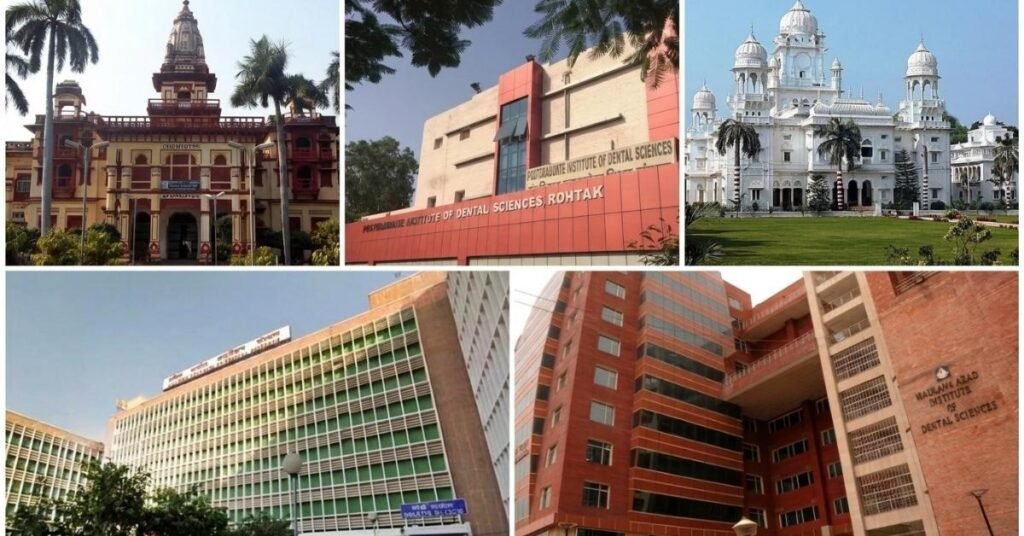
In my experience counseling hundreds of NEET aspirants, government dental colleges remain the most sought-after destinations. The reason is straightforward. You get world-class clinical training at a fraction of the cost a private college would charge.
Here is a quick comparison of the top 5 government dental colleges in India:
| College Name | Location | Est. Annual Fees | NEET Cutoff Level |
| AIIMS Delhi | New Delhi | Rs. 1,000 – 5,000 | Extremely High |
| Maulana Azad Institute of Dental Sciences (MAIDS) | New Delhi | Rs. 20,000 – 30,000 | Very High |
| King George’s Medical University (KGMU) | Lucknow | Rs. 25,000 – 35,000 | Very High |
| Post Graduate Institute of Dental Sciences (PGIDS) | Rohtak | Rs. 15,000 – 25,000 | High |
| Banaras Hindu University (BHU) | Varanasi | Rs. 10,000 – 40,000 | High |
Why Government Colleges Are So Competitive
The demand is simple to explain. Seats are very limited. AIIMS Delhi, for example, offers only a handful of BDS seats each year. With lakhs of students appearing for NEET UG, even a score in the top 0.1 percentile may not be enough for AIIMS.
MAIDS and KGMU are slightly more accessible but still demand scores that place you well within the top few thousand ranks nationally.
What Makes These Colleges Worth the Fight
The clinical exposure at government colleges is genuinely unmatched. I have spoken to graduates from MAIDS and BHU who handled complex extractions, root canals, and prosthetic cases independently before finishing their third year. That kind of hands-on training is hard to replicate.
Government hospitals attached to these colleges see thousands of patients every single day. As a student, that means real cases, real pressure, and real learning from day one.
A few more reasons why government dental colleges stand apart:
- Fees are heavily subsidized, making the total BDS cost under Rs. 2 lakhs in most cases.
- Faculty at institutions like AIIMS and KGMU include some of India’s most published dental researchers.
- Government college degrees carry strong credibility during MDS entrance exams and public sector job applications.
- Hostel and campus facilities are reliable and affordable compared to private counterparts.
If your NEET score puts you in contention for any of these five colleges, prioritize them without hesitation.
Top 5 Private Dental Colleges: Advanced Infrastructure and High ROI
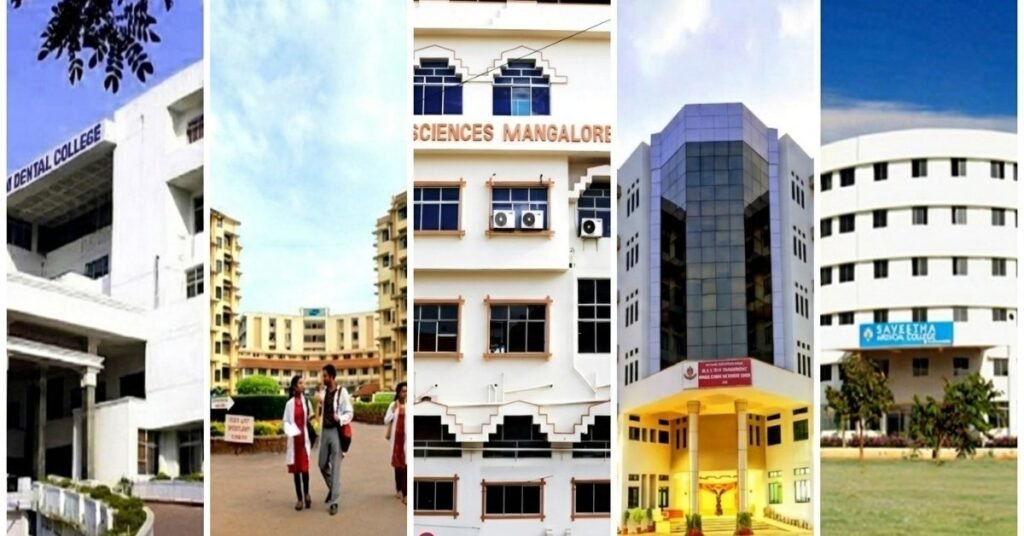
Private dental colleges often get dismissed because of their fees. That is a mistake I see students and parents make repeatedly. The right private college, chosen carefully, can deliver clinical training and infrastructure that rivals the best government institutions in India.
Here is a comparison of the top 5 private dental colleges based on NIRF 2025 rankings:
| College Name | Location | Est. Total Fees (5 Years) | Placement Strength |
| Saveetha Institute of Medical and Technical Sciences | Chennai | Rs. 20 – 25 Lakhs | Strong (Research + Clinical) |
| Dr. D.Y. Patil Vidyapeeth | Pune | Rs. 25 – 30 Lakhs | Strong (Hospital Network) |
| Manipal College of Dental Sciences (MCODS) | Manipal | Rs. 22 – 28 Lakhs | Very Strong (Global Alumni) |
| A.B. Shetty Memorial Institute of Dental Sciences | Mangalore | Rs. 18 – 24 Lakhs | Moderate to Strong |
| SRM Dental College | Chennai | Rs. 15 – 22 Lakhs | Moderate to Strong |
The Fee Reality Check
Yes, private dental colleges are expensive. A five-year BDS program at Saveetha or D.Y. Patil can cost your family Rs. 20 to 30 lakhs in total. That is a significant investment and I will never pretend otherwise.
But here is what that investment actually buys you.
What You Get at These Private Colleges
Saveetha Institute is ranked #2 in India for a reason. It has one of the largest dental schools in Asia, with dedicated simulation labs, digital dentistry units, and a research output that consistently places it among the top institutions globally.
Manipal College of Dental Sciences has an alumni network spread across the US, UK, Australia, and the Middle East. For students considering a career abroad, this matters enormously.
D.Y. Patil benefits from a large attached hospital that ensures consistent patient flow and diverse clinical case exposure throughout the BDS program.
A few more points worth knowing:
- NEET cutoffs at these private colleges are significantly lower than government institutions, making them accessible to a wider range of scores.
- Most of these colleges offer education loans through tie-ups with nationalized banks, easing the financial burden.
- Infrastructure at Saveetha, Manipal, and D.Y. Patil includes equipment that many government colleges in smaller cities simply do not have.
- Private colleges tend to have faster administrative processes for internships, certifications, and international exchange programs.
The fee is high. The opportunity, if used well, is higher.
BDS Admission Process and NEET 2026 Guidelines
Every single BDS seat in India, whether at a government or private college, is filled through NEET UG. There is no other way in. No management quota back door that bypasses NEET. No direct admission based on 12th board marks alone.
Here is exactly how the process works:
Eligibility Criteria
Before anything else, confirm you meet these basic requirements:
- You must have passed Class 12 with Physics, Chemistry, and Biology as core subjects.
- Minimum marks required in PCB combined is 50% for general category students (40% for SC/ST/OBC).
- You must be at least 17 years of age on or before 31st December of the admission year.
Step-by-Step Admission Process for BDS 2026
Step 1: Register and appear for NEET UG 2026 through the official NTA portal at neet.nta.nic.in.
Step 2: Wait for NEET UG results and note your score and All India Rank (AIR).
Step 3: Register for MCC counseling (for 15% All India Quota seats) or your respective State Counseling Authority.
Step 4: Fill in your college and course preferences carefully during the choice filling window.
Step 5: Seat allotment is released based on your rank, category, and preference order.
Step 6: Report to the allotted college with original documents within the deadline to confirm your seat.
Missing any deadline in this process means losing your seat permanently. Set reminders. Stay alert.
Want to Convert Percentage to CGPA?
Quickly convert your percentage into CGPA with our accurate and easy-to-use calculator.
Convert NowCareer Scope and Salary After BDS in India
A BDS degree opens more doors than most students realize at the time of admission. The challenge is that those doors do not all open at the same time or at the same salary.
Here is an honest breakdown of what to expect:
Starting Salaries After BDS
- Fresh BDS graduates working in private dental clinics or hospitals typically earn between Rs. 15,000 to Rs. 35,000 per month initially.
- Government dental officer positions through state PSC exams offer Rs. 40,000 to Rs. 70,000 per month with job security and benefits.
- Corporate dental chains like Clove Dental or Sabka Dentist offer structured packages ranging from Rs. 25,000 to Rs. 50,000 per month for freshers.
Why Most Toppers Choose MDS
An MDS specialization in orthodontics, oral surgery, or prosthodontics can push your earning potential to Rs. 1.5 to 4 lakhs per month within five years of practice. That jump is significant and explains why competitive students immediately target MDS entrance exams after BDS.
The Private Clinic Reality
Setting up your own clinic requires an investment of Rs. 10 to 25 lakhs minimum. Most graduates need three to five years of employed practice before that becomes financially viable.
The career is strong. Patience in the early years is non-negotiable.
Conclusion and Final Verdict
Choosing between a government and private dental college comes down to two things: your NEET score and your financial situation.
If your rank puts you in contention for AIIMS Delhi, MAIDS, KGMU, PGIDS Rohtak, or BHU, take that seat without a second thought. The fees are minimal and the training is exceptional.
If your score falls short of government cutoffs, do not panic. Saveetha, Manipal, D.Y. Patil, and A.B. Shetty are genuinely strong institutions. The investment is higher but so is the infrastructure and accessibility.
Whatever you choose, commit fully. The dental profession rewards those who put in the clinical hours early and plan their MDS or career path before graduation.
Frequently Asked Questions
Which is the No. 1 BDS college in India?
AIIMS Delhi is the top ranked dental college in India according to NIRF 2025 rankings, with a score of 89.12. It is a government institution offering world-class dental education at minimal fees.
Is NEET mandatory for BDS admission?
Yes, NEET UG is the only valid entrance exam for BDS admission across all government and private dental colleges in India. There is no alternative route for admission.
What is the average fee for private dental colleges in India?
The total five-year BDS fee at top private dental colleges ranges between Rs. 15 lakhs to Rs. 30 lakhs depending on the institution and location. Education loans are widely available through nationalized banks.
Can I get a good job without doing MDS?
Yes, fresh BDS graduates can work in corporate dental chains, government health programs, or private clinics with decent starting salaries. However, MDS specialization significantly increases long-term earning potential and career growth.
Which city has the most top-ranked dental colleges in India?
Delhi and Chennai have the highest concentration of top-ranked dental colleges in India. Delhi has strong government institutions while Chennai is home to top private deemed universities like Saveetha and SRM.
What is the NEET cutoff for government dental colleges in India?
Government dental colleges like AIIMS Delhi and MAIDS require extremely high NEET scores, typically placing you within the top few thousand ranks nationally. Cutoffs vary each year based on the number of applicants and seats available.