

NLSIU Bengaluru holds the NIRF Rank 1 position among law universities in India. For CLAT aspirants, the top National Law Universities (NLUs) remain the gold standard. Private colleges like Symbiosis Law School Pune and Jindal Global Law School offer strong alternatives.
A law degree can open doors that most careers cannot. Courtrooms, corporations, policy rooms, international tribunals lawyers shape decisions that affect millions.
But picking the wrong college can cost you years.
This guide cuts through the noise. Every name, every rank, every fact here comes from official NIRF data and verified sources nothing invented, nothing exaggerated.
The Legal Education Landscape: NLUs vs. Private Universities
India has over 1,500 law colleges. Yet only a handful genuinely prepare students for high-stakes legal careers. The difference between a good law college and a great one is not just a building or a library. It is the quality of faculty, the strength of alumni networks, and the reputation that follows your degree for life.
National Law Universities (NLUs) are autonomous, government-established institutions created specifically to elevate legal education. Admission happens through CLAT — one of India’s most competitive entrance exams. According to the Consortium of NLUs, there are currently 24 NLUs across India, each with a distinct academic focus.
Private universities, on the other hand, offer greater flexibility. Some accept JEE-style entrance scores, management quotas, or university-level tests. They often invest heavily in international exposure, moot court facilities, and industry tie-ups.
| Feature | NLUs (Govt) | Top Private Universities |
| Admission Route | CLAT | University-level / CLAT |
| Fees | Moderate | Higher |
| Global Exposure | Moderate | High (especially JGLS) |
| NIRF Presence | Dominant | Growing |
| Alumni Network | Very Strong | Strong |
Both paths can build exceptional lawyers. Your choice depends on your goals, budget, and entrance exam performance.
Top 10 Government Law Universities in India
Government law universities in India, especially the NLUs, carry decades of academic credibility. These institutions are built around rigorous legal training, competitive peer groups, and strong placement records. Here is a verified, NIRF-based breakdown of the top 10.
National Law School of India University (NLSIU), Bengaluru

NLSIU Bengaluru holds the NIRF Rank 1 position in law and has held it consistently across recent official rankings. It is the oldest and most prestigious NLU in India. The five-year BA LLB programme here is considered a benchmark for legal education across South Asia. Recruiters from top-tier law firms and the judiciary actively seek NLSIU graduates.
National Law University (NLU), New Delhi
NLU Delhi ranks second in recent NIRF data and is widely regarded as the most difficult NLU to enter through CLAT. Its proximity to the Supreme Court of India gives students unmatched access to internships, court observations, and legal research opportunities. The academic culture here is intensely competitive and deeply rewarding.
NALSAR University of Law, Hyderabad
NALSAR Hyderabad secures NIRF Rank 3 and is known for producing lawyers who lead in litigation, corporate law, and public policy. The university has a strong research culture and an active legal aid clinic that gives students real-world exposure before they even graduate. Faculty here includes practitioners who have argued before constitutional benches.
The West Bengal National University of Juridical Sciences (WBNUJS), Kolkata
WBNUJS Kolkata holds NIRF Rank 4 and is one of the founding NLUs of India. It has a particularly strong reputation in corporate law and intellectual property. The university regularly collaborates with international institutions, giving students access to cross-border legal research and global moot court competitions.
Gujarat National Law University (GNLU), Gandhinagar
GNLU Gandhinagar ranks fifth in recent NIRF data. Located in Gujarat’s capital, the university benefits from its proximity to one of India’s most active commercial and industrial hubs. GNLU has carved a niche in arbitration, corporate law, and legal entrepreneurship. Its placement record in business law roles is among the strongest outside the top three NLUs.
Confused About Your Overall CGPA?
Use our SGPA to CGPA calculator to instantly calculate your final CGPA from all semesters.
Calculate CGPAIIT Kharagpur – Rajiv Gandhi School of Intellectual Property Law

This is the only law school in India that operates inside an IIT campus. The Rajiv Gandhi School of Intellectual Property Law at IIT Kharagpur holds NIRF Rank 6 and is the go-to destination for students who want to combine technology and law. If your interest lies in patents, tech regulation, or IP litigation, no other institution in India offers this level of interdisciplinary depth.
Jamia Millia Islamia, New Delhi
Jamia Millia Islamia ranks eighth in recent NIRF data. As a central university, it offers law education at a significantly lower fee structure compared to most NLUs. The Faculty of Law at Jamia has a strong tradition in constitutional law, human rights, and criminal justice. Its Delhi location provides students with proximity to courts, legal aid organisations, and policy bodies.
Aligarh Muslim University (AMU), Aligarh
AMU holds NIRF Rank 9 in law. One of India’s oldest central universities, AMU’s Faculty of Law brings historical depth to its programmes. The university has a large and loyal alumni base spread across the judiciary, civil services, and the bar. Students here benefit from a well-established legal culture that stretches back over a century.
Babasaheb Bhimrao Ambedkar University (BBAU), Lucknow
BBAU Lucknow secures NIRF Rank 12 in law. As a central university named after Dr B.R. Ambedkar, constitutional law and social justice are embedded into the academic DNA of this institution. Its location in Lucknow, the seat of the Allahabad High Court’s bench, gives students direct access to one of India’s busiest legal ecosystems.
Cochin University of Science and Technology (CUSAT), Cochin
CUSAT holds NIRF Rank 13 in law and is a leading institution in South India outside the NLU system. The School of Legal Studies at CUSAT is particularly strong in maritime law, environmental law, and technology law — areas that are growing rapidly in importance. Kerala’s robust civil society and active high court make it an excellent training ground.
5 Best Private Law Colleges in India
Not every student who wants a strong legal career will clear CLAT with a top-100 rank. Private law universities have stepped up to fill that gap, and several of them now feature directly in official NIRF rankings alongside government institutions. That alone speaks to how seriously they are taken today.
| University | Location | Known For |
| Symbiosis Law School (SLS) | Pune, Maharashtra | Corporate law, MNC placements, global curriculum |
| Siksha ‘O’ Anusandhan (SOA) | Bhubaneswar, Odisha | Research output, affordable fees, NIRF recognition |
| SASTRA University | Thanjavur, Tamil Nadu | Academic rigour, South India presence, consistent NIRF rank |
| KIIT School of Law | Bhubaneswar, Odisha | Industry tie-ups, campus infrastructure, placement record |
| Jindal Global Law School (JGLS) | Sonipat, Haryana | International faculty, global exposure, foreign collaborations |
Why Private Law Colleges Deserve Serious Consideration

Symbiosis Law School Pune holds NIRF Rank 7, making it the highest-ranked private law college in India in recent official data. Its curriculum is built around corporate and international law, and its placement cell has consistent connections with multinational firms.
Jindal Global Law School (JGLS) is in a category of its own when it comes to global legal education in India. It partners with law schools across the United States, United Kingdom, and Europe. Students here gain exposure to international arbitration, human rights law, and comparative legal systems that most Indian law schools simply do not offer.
KIIT School of Law in Bhubaneswar has built a strong placement infrastructure backed by its parent university’s industry network. For students who want strong campus life alongside legal training, KIIT delivers both.
SOA and SASTRA may not carry the same brand recognition as JGLS or Symbiosis, but their consistent NIRF rankings prove their academic seriousness. Both are excellent choices for students in Odisha and Tamil Nadu who want quality legal education close to home.
Private colleges work best for students who value flexibility, international curricula, or have a specific geographic preference.
Admission Requirements and Entrance Exams
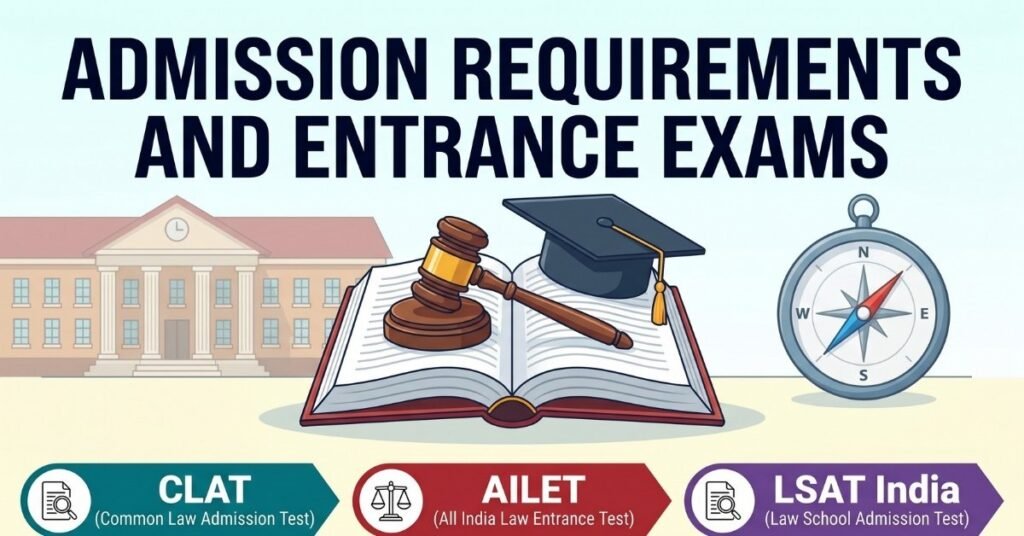
Getting into the best law university in India requires clearing the right entrance exam. Each university or group of universities has its own admission route. Understanding these early gives you a real edge over other applicants.
The Three Main Entrance Exams
CLAT (Common Law Admission Test)
- The primary gateway to all 24 NLUs across India
- Tests English, logical reasoning, legal aptitude, quantitative skills, and current affairs
- Conducted annually by the Consortium of NLUs
- A score in the top 100 opens doors to NLSIU, NLU Delhi, and NALSAR
- Available for both undergraduate (BA LLB) and postgraduate (LLM) admissions
AILET (All India Law Entrance Test)
- Conducted exclusively by NLU Delhi for admission to its own programmes
- Separate from CLAT, so students aiming for NLU Delhi must register independently
- Known for being highly competitive with a very limited intake per batch
LSAT India (Law School Admission Test)
- Primarily used by private law universities including Jindal Global Law School
- Tests analytical and logical reasoning rather than law-specific knowledge
- A strong LSAT score can open multiple private university options simultaneously
General Eligibility Criteria
- Minimum 45% marks in Class 12 (40% for reserved categories)
- No upper age limit for undergraduate law programmes at most NLUs
- Some private universities also conduct their own entrance tests or accept direct applications
Checking each university’s official admissions page through the NIRF portal helps verify current eligibility conditions before applying.
Worried About Attendance Shortage?
Find out how many classes you can skip and still stay above the required attendance limit.
Check AttendancePlacements, ROI, and Real Student Concerns
Law school is a five-year commitment. Before signing an admission form, every serious student asks the same hard questions. Here are honest answers.
Are tier-2 NLUs worth it?
Yes, with realistic expectations. NLUs like GNLU, WBNUJS, and NALSAR place students consistently in top law firms, corporate legal teams, and the judiciary. Even NLUs ranked between 5 and 10 carry the NLU brand, which still holds significant weight with recruiters across India.
The gap between tier-1 and tier-2 NLUs exists, but it is not insurmountable. Your internship record, moot court experience, and academic performance matter far more than rank alone after your first job.
Is the high fee of private law schools justified?
For Jindal Global Law School, largely yes — if your goal is international law, global arbitration, or a foreign LLM. JGLS alumni regularly secure positions in global firms and international organisations.
For other private colleges, the ROI depends heavily on the specialisation you choose and the effort you put into networking during your five years.
What do recruiters actually look for?
- Internship quality over quantity
- Moot court and research publication record
- Communication skills and legal drafting ability
- College reputation plays a role early in career, less so after 3-5 years of experience
Can a student from a private college outperform an NLU graduate?
Absolutely. The degree opens the door. What you do inside law school determines everything after it.
Final Verdict on Choosing Your Law School
The best law university in India is not a single name. It is the one that matches your entrance exam performance, career goals, and financial reality.
NLSIU Bengaluru leads the official rankings. NLU Delhi is the hardest to crack. Jindal Global Law School leads in international exposure. Symbiosis Law School Pune leads among affordable private options.
Every institution listed in this guide is verified, ranked, and respected.
Your effort inside the college will always outweigh the name on your degree. Choose wisely, prepare seriously, and commit fully.
Frequently Asked Questions
Q1. Which is the number one law university in India?
National Law School of India University (NLSIU), Bengaluru holds the NIRF Rank 1 position among law universities in India according to recent official NIRF rankings. It is consistently rated the best law university in India for academic rigour, faculty quality, and placement record.
Q2. Which exam do I need to crack to get into the best NLUs?
CLAT (Common Law Admission Test), conducted by the Consortium of NLUs, is the primary entrance exam for all 24 National Law Universities in India. NLU Delhi additionally requires AILET for its own admissions separately from CLAT.
Q3. What is the best private law college in India?
Symbiosis Law School Pune holds NIRF Rank 7, making it the highest-ranked private law college in recent official data. Jindal Global Law School is the top choice for students seeking international legal exposure and global career opportunities.
Q4. Are government NLUs better than private law colleges?
NLUs generally offer stronger brand value, lower fees, and deeper roots in India’s legal ecosystem. However, private universities like JGLS offer superior global exposure and international faculty. The better choice depends entirely on your specific career goals.
Q5. What is the minimum eligibility to apply for law in India?
Most NLUs and private law universities require a minimum of 45% marks in Class 12 from a recognised board. Reserved category students typically need 40%. There is no upper age limit for undergraduate law programmes at most NLUs.
Q6. Is a law degree from a tier-2 NLU worth it?
Yes. Tier-2 NLUs like GNLU Gandhinagar, WBNUJS Kolkata, and NALSAR Hyderabad still carry strong NLU brand recognition with legal recruiters across India. Placement outcomes depend significantly on individual performance, internship quality, and specialisation chosen during the programme.